العربيةع Start free

Fundraising and impact, finally in one agentic system.

Targetthe right funders.

Writecoherent proposals.

Reporton your work and impact.

Without pulling your team off program delivery.

Run the diagnostic and get your report in 10 minutes. Free, no credit card.

Built for nonprofits that want to widen their funding base and build donor relationships that outlast a single grant.

Nonprofits already working with us.

Raising funds and delivering impact are different skillsets
and nothing in your stack connects them.

Most organizations treat fundraising as proposal writing, and each proposal as a fresh start. So proposals get written in a different room from where strategy, delivery, evidence, and follow-up actually happen. Every cycle begins from zero, and what you learned last time stays in someone's inbox.

Fundraising work: writing proposals, finding funders, compliance records, donor relationships. Impact work: program design, project delivery, tracking outcomes, theory of change, community outreach.

Result

Wasted energy in seeking resources, and projects that stray from your mission.

ChatGPT can draft a section.
It doesn't know your funders or your last report.

Drafting was never the hard part.

? ? ? THE MISSING SYSTEM WritingProposals Theory ofChange DataAnalysis DonorReporting OrgLearning SectorKnowledge OrgContext DonorResearch RelationshipHistory DataCollection PipelineTracking StrategyAlignment GrantBudgeting
✕

It doesn’t know the MENA landscape

What a Gulf foundation weighs, what your team learned from the last project; your team supplies all of it every time, or forgets to.

✕

Nothing carries between tasks

Every prompt starts empty. Strategy, proposal, evidence, and reporting connect only by what someone remembers to copy across.

Nasaq is the system that aligns your fundraising with your mission.

Three modules on one shared record, so strategy, proposals and evidence all draw on the same understanding of your organization.

Targetthe right funders for you

Free to try

Score your organization across seven capacities and see which funding pathways are open to you today, and what is holding the others shut. The diagnostic and its report are free.

Get your funding map

Writeproposals that honor your mission

Closed pilot

Qualification, go/no-go, and proposals assembled from your own evidence and past submissions rather than from a blank page.

Provethe impact you delivered

Free to try

Evidence collected while the work happens and mapped back to what you promised, so reports and renewals are assembled instead of reconstructed.

Try Athar free
Book a discovery call

Proposal writing is in a closed pilot with a small circle of partners.

The three modules in action.

Functioning and improving everyday. A demo walks one real opportunity through the whole lifecycle; these are shots from it.

01Target

Go after the funding that fits you, and skip the rest.

Nasaq matches your organization against opportunities across funding channels: institutional donors, foundations, companies, government and individual giving. It flags the ones you are not eligible for or not competitive in, and the ones that pull away from your strategy and priorities, so your team spends its effort where it can win.

  • Less time lost on applications that were never going to land
  • Higher success rates on the ones you pursue

Free to try

Get your funding map
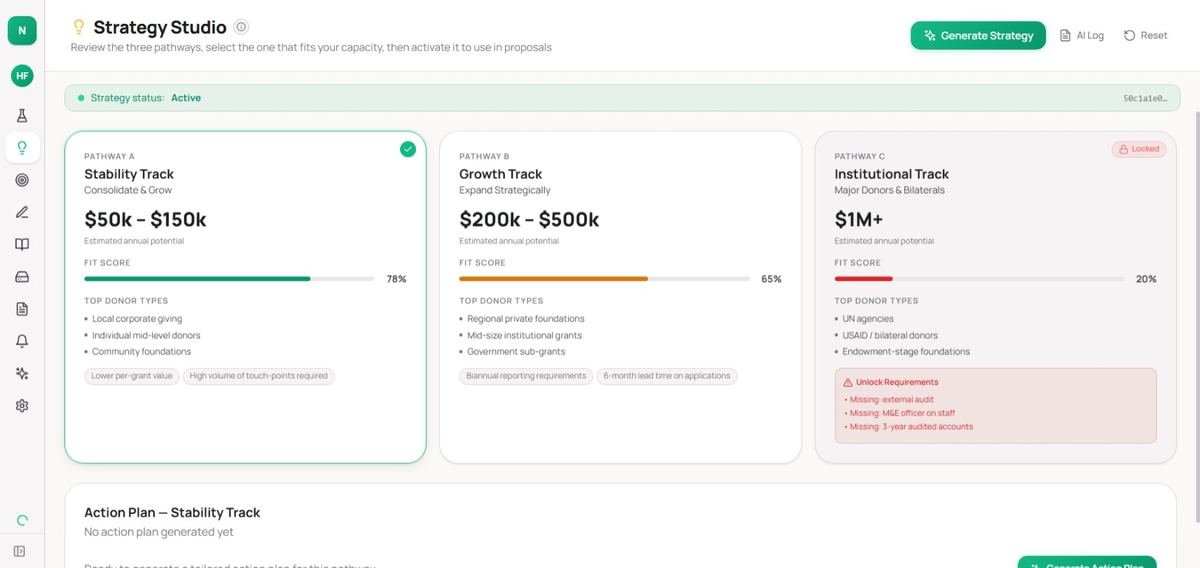
Strategy Studio showing three funding pathways with fit scores; the third is locked with its unlock requirements listed
Strategy Studio. Pathway C is locked on three named requirements, not on a score.

02Write

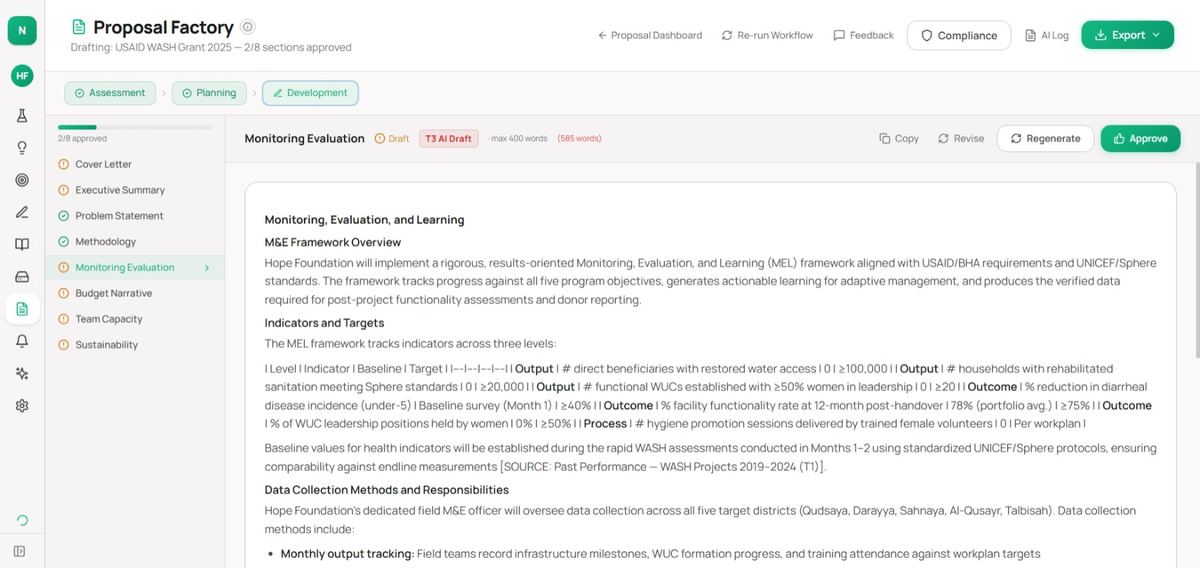
Proposals written from everything your organization already knows.

Past proposals, concept notes, project reports and field updates from Telegram build up into one record of your work. Nasaq drafts proposals and other funding documents from that record and shows where each claim came from, so you review and approve instead of starting from a blank page.

  • Every draft builds on your real track record
  • Each claim links back to its source

Closed pilot

Proposal Factory drafting a Monitoring and Evaluation section, with an inline citation to past WASH project performance
Proposal Factory, mid-draft. The bracketed source is the system showing its work.

03Prove

Monthly reports without the month-end phone calls.

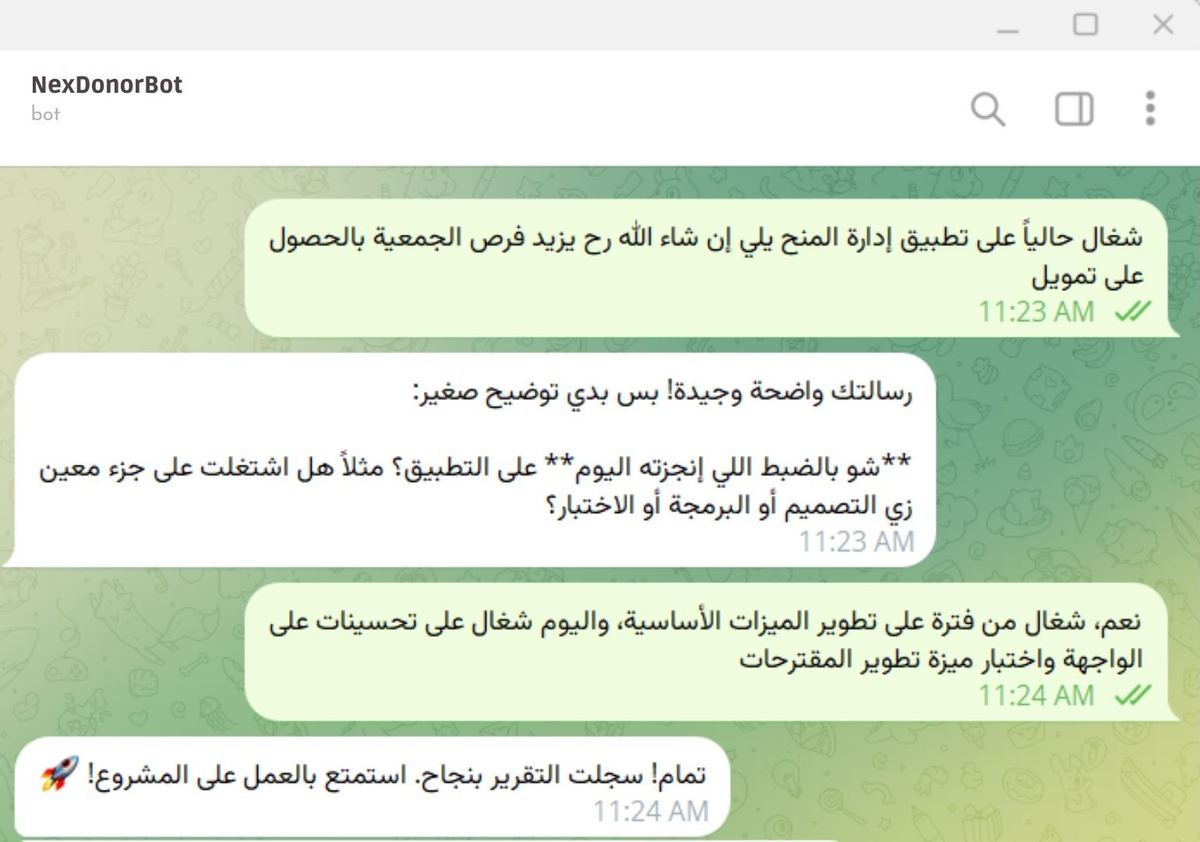
Your field team sends short updates on Telegram as they work. The bot asks for whatever detail is missing and gathers everything into one organized record, so managers stop chasing everyone by phone at the end of the month.

  • Detailed reports built from daily updates
  • Nothing new for the field team to install

Free to try

Try it free
A Telegram conversation in Arabic where the reporting bot asks a staff member to be more specific about the day's work
Evidence intake over Telegram. The bot pushes back when an update is too vague to use.
How it works

Eight activities. One shared context.

Nasaq connects the strategic side of fundraising (fit, tradeoffs, alignment) to the execution side: proposal writing, compliance, reporting. All of it reads from and writes to the same shared context at the center.

Strategy & Theory of ChangeWe help you build a coherent, logical theory of change.
Donor mappingWe study your region's funder landscape: who funds what, and what they look for.
Capacity assessmentAssess organizational readiness and build toward funder requirements step by step.
Problem framingFrame the problem in donor language backed by field evidence.
Proposal writingAssemble proposal packages from data and documents already stored in the system.
Donor engagementManage donor relationships, regular follow-ups, and correspondence tracking.
Evidence collectionIngest and organize field data so it's ready for reports and proposals.
ReportingGenerate donor reports from collected data; no copy-pasting.
Donor needs
Your mission & capacity
Community needs & resources

Each activity writes to that shared context and reads from it. Nothing gets copy-pasted, and the next cycle starts with everything the last one learned.

Built by

Two founders. Deep in the work.

Experienced consultants working with you directly. There is no sales layer, and no account manager mediating the operations.

Nart Abaza
Nart Abaza
  • Productivity & AI
  • PMP
  • MEAL DPro
  • 10+ yrs among nonprofits

He kept watching nonprofits lose institutional knowledge between funding cycles, then drift from their mission chasing donor criteria. Engineer by training; ten years across eleven MENA countries building operating systems for organizations, from government OKR dashboards to NGO reporting workflows.

Ahmed H. Osman
Ahmed H. Osman
  • Strategy & community development
  • PhD candidate, Marketing & Strategy
  • MSc Innovation Mgmt, Cairo & Cambridge

He saw how far apart strategy, evidence and funding cycles sit for organizations working in the hardest contexts. Ministry-level strategy for UNFPA, participatory research for Interpeace, field work across KSA, Yemen, Sudan, Jordan and Egypt, plus governance rigor carried over from financial services.

Questions, answered.

Is this a CRM replacement?+

Not by default but it can be. This depends on the maturity of your current systems.

Is this a grant management system?+

The goal is much more than manage grants. It's a comprehensive system for managing the entire fundraising lifecycle and aims to help you think and act beyond the classic donor patterns.

What's included in the MVP vs the roadmap?+

The MVP is a working end-to-end system across the lifecycle, with the Funding workflow as the most mature (intake → qualification → go/no-go → proposal factory → decision log). Evidence/Follow-up chatbots are already running for tens of users. The roadmap still carries very interesting pieces like Theory of Change alignment and campaign management. Pilot orgs are shaping that with us.

What does onboarding look like, and how long does it take?+

Onboarding is lightweight and designed not to disrupt active submissions: (1) A 45 to 60 min discovery call (your current workflow, tools, and priorities); (2) Configure your pipeline stages, decision criteria, and a proposal pack structure; (3) Import or start with a small set of live opportunities (usually 5 to 15); (4) Align roles and permissions; set evidence capture basics for post-award. Typical pilot setup: one week.

What languages are supported (Arabic / English)?+

Arabic and English are supported as first-class use cases. We're building for bilingual teams, including Arabic-first workflows and right-to-left interfaces throughout. If your team works in mixed language (Arabic internally, English externally), you can structure outputs accordingly.

How do you handle sensitive data?+

We default to least-access, role-based permissions, and clear separation between internal notes and donor-facing outputs. We can support: Access controls by role (e.g., leadership vs proposal writer vs programs/M&E); Auditable decision logs (who decided what, and why); Data minimization in pilots (start with only what's necessary). We'll align data residency and hosting/security specifics during the pilot intake, based on your organization's requirements.

Map your funding readiness, or talk to us about the pilot.

The funding readiness check and Athar, our field-evidence bot, are free and open to try today. Proposal writing is in a closed pilot with a small circle of partners, and a call is how you join.

Get your funding map Free, about 10 minutes. The report is yours to keep and to share.
Book a discovery call See a demo, talk through customization, or ask about joining the pilot.

Not ready for either? We’ll tell you when the rest opens up.

Occasional product updates. No spam, and you can unsubscribe in a click.